Achieving climate neutrality will prove to be an unprecedented challenge for the European Union. As the European Climate Law states, reaching the objective of climate neutrality within the European Union by 2050 will require efforts from all economic sectors in the Union. For energy-intensive industries such as cement, lime, and steel – key industrial chainsContinue reading “ZEP response to consultation on Carbon Border Adjustment Mechanism”
Post type Archives
Response to the consultation on EU Emissions Trading System
ZEP supports the European Union’s commitment to reach climate neutrality by 2050, defined as net-zero greenhouse gas (GHG) emissions by 2050. To this end, carbon capture and storage (CCS) and carbon capture and utilisation (CCU) technologies play a crucial role. In the context of the revision of the EU ETS Monitoring and reporting rules, ZEPContinue reading “Response to the consultation on EU Emissions Trading System”
ZEP’s response to the revision of the Trans-European Energy Infrastructure (TEN-E) regulation
ZEP supports the European Union’s commitment to reach climate neutrality by 2050, defined as net-zero greenhouse gas (GHG) emissions by 2050. To this end, carbon capture and storage (CCS) and carbon capture and utilisation (CCU) technologies play a crucial role. As geological storage sites are not evenly distributed among member states, the large-scale deployment ofContinue reading “ZEP’s response to the revision of the Trans-European Energy Infrastructure (TEN-E) regulation”
Input to DG CLIMA on the Innovation Fund – challenges for CCS projects and lack of alignment with the Taxonomy
The Zero Emissions Platform (ZEP) would like to thank the European Commission for a transparent process leading up to the planned first call of the Innovation Fund. ZEP appreciates the opportunity to provide feedback and engage with DG CLIMA at the Expert Group meetings, as well as in bilateral meetings, and is thankful for theContinue reading “Input to DG CLIMA on the Innovation Fund – challenges for CCS projects and lack of alignment with the Taxonomy”
ZEP response to the consultation on 2030 climate target plan
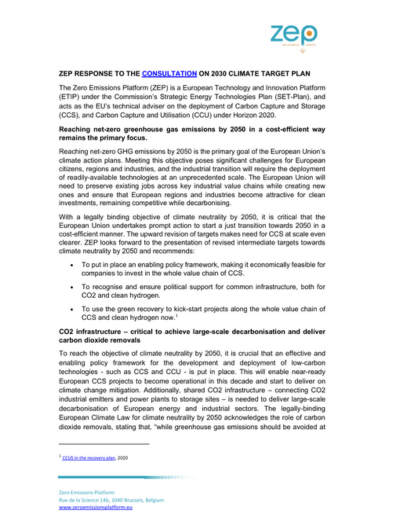
Reaching net-zero greenhouse gas emissions by 2050 in a cost-efficient way remains the primary focus. With a legally binding objective of climate neutrality by 2050, it is critical that the European Union undertakes prompt action to start a just transition towards 2050 in a cost-efficient manner. The upward revision of targets makes the need forContinue reading “ZEP response to the consultation on 2030 climate target plan”
Response to the Roadmap on an EU Hydrogen strategy
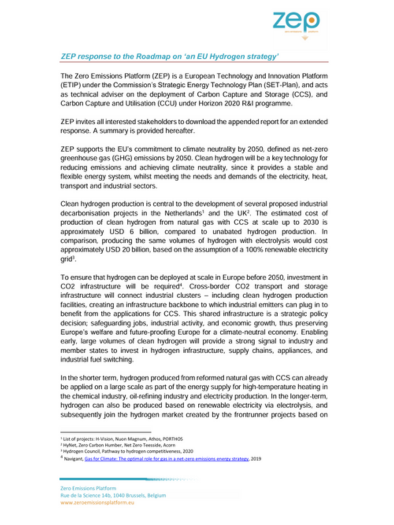
ZEP supports the EU’s commitment to climate neutrality by 2050, defined as net-zero greenhouse gas (GHG) emissions by 2050. Clean hydrogen will be a key technology for reducing emissions and achieving climate neutrality, since it provides a stable and flexible energy system, whilst meeting the needs and demands of the electricity, heat, transport, and industrialContinue reading “Response to the Roadmap on an EU Hydrogen strategy”
ZEP response to the roadmap on TEN-E regulation
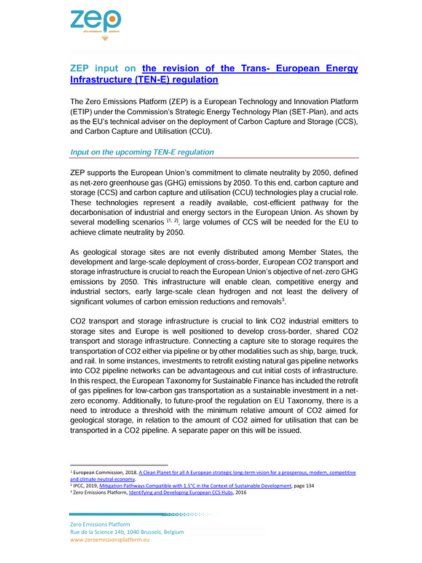
ZEP supports the European Union’s commitment to climate neutrality by 2050, defined as net-zero greenhouse gas (GHG) emissions by 2050. To this end, carbon capture and storage (CCS) and carbon capture and utilisation (CCU) technologies play a crucial role. These technologies represent a readily available, cost-efficient pathway for the decarbonisation of industrial and energy sectorsContinue reading “ZEP response to the roadmap on TEN-E regulation”
Response to the Roadmap on Strategy for Energy System Integration
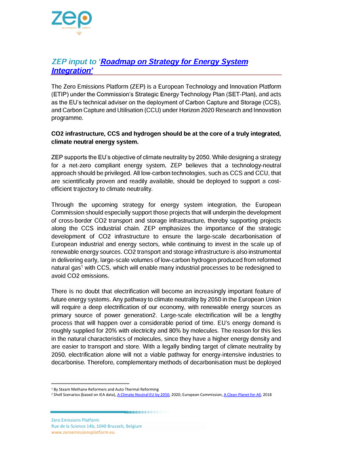
CO2 infrastructure, CCS, and hydrogen should be at the core of a truly integrated, climate-neutral energy system. ZEP supports the EU’s objective of climate neutrality by 2050. While designing a strategy for a net-zero compliant energy system, ZEP believes that a technology-neutral approach should be privileged. All low-carbon technologies, such as CCS and CCU, thatContinue reading “Response to the Roadmap on Strategy for Energy System Integration”
ZEP response to 2030 Climate Target Plan
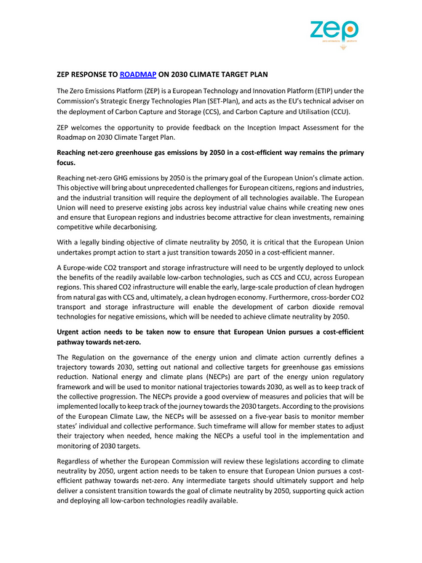
Reaching net-zero GHG emissions by 2050 is the primary goal of the European Union’s climate action. This objective will bring about unprecedented challenges for European citizens, regions and industries, and the industrial transition will require the deployment of all technologies available. The European Union will need to preserve existing jobs across key industrial value chainsContinue reading “ZEP response to 2030 Climate Target Plan”
Response to public consultation on European Climate Law
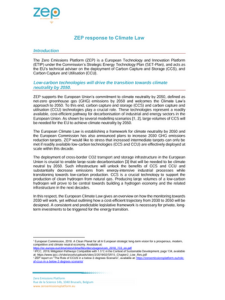
ZEP supports the European Union’s commitment to climate neutrality by 2050, defined as net-zero greenhouse gas (GHG) emissions by 2050 and welcomes the Climate Law’s approach to 2050. To this end, carbon capture and storage (CCS) and carbon capture and utilisation (CCU) technologies play a crucial role. These technologies represent a readily available, cost-efficient pathwayContinue reading “Response to public consultation on European Climate Law”