
From barrier to enabler: the role of the London Protocol in advancing CCS across Europe
Drawing on ZEP’s participation in the latest Meeting of the Contracting Parties to the London Protocol, this article explains how the legal framework for cross-border CO₂ transport and offshore storage has evolved, where it stands today, and how it connects to the upcoming EU framework for CO₂ transport and infrastructure. It also explores the lessons this process may offer for other regional treaties that continue to create barriers to CCS.
Cross-border transport of carbon dioxide (CO2) will be essential for scaling up carbon capture and storage (CCS) in Europe. However, these activities are governed not only by European and national laws but also by international environmental law, such as the London Convention and the London Protocol and regional maritime conventions such as OSPAR Convention (North East Atlantic), Helsinki Convention (Baltic Sea) and Barcelona Convention (Mediterranean Sea).
The European Commission is preparing a proposal for a European CO2 market and transport infrastructure framework, expected in mid-2026. As this initiative develops, understanding how international law regulates cross-border CO₂ transport and storage in Europe is becoming increasingly important.
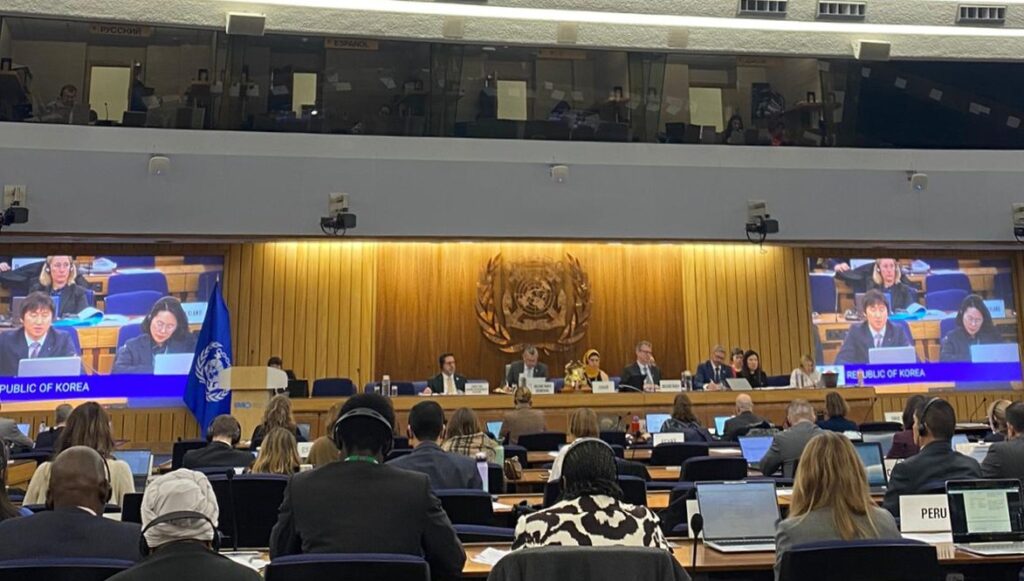
These issues were discussed during the 47th Meeting of the Contracting Parties to the London Convention and the 28th Meeting of the Contracting Parties to the London Protocol, which the Zero Emissions Platform (ZEP) attended.
The legal challenges behind cross-border CO₂ transport
Transporting CO2 requires extensive planning, special equipment, infrastructure, and strict safety measures. Storing it, particularly offshore, adds another layer of complexity.
However, technical and financial challenges are not the only barriers. Cross-border CO₂ movement and storage also raise significant legal challenges, shaped by decades of international environmental law.
To protect the marine environment, a web of national laws, regional frameworks, and international treaties regulate what can be placed under the seabed. These rules define how countries and companies may interact with marine spaces. As a result, they directly influence whether and under which conditions cross-border CO₂ transport and storage can take place.
At the international level, the London Convention and London Protocol play a key role in governing the legality of transporting CO2 through the sea and storing it offshore. As the European Commission prepares a proposal for an EU CO₂ market and transport infrastructure legislation, two key questions emerge:
- How has the London Protocol regime evolved to accommodate offshore CO₂ storage and related cross-border transport of CO₂?
- What are the implications for industrial carbon management and how does this relate to the EU and international legal frameworks?
The London Protocol and CO₂: from obstacle to enabler
To answer the first question, it is helpful to look at how the legal regime has evolved over the last decades.
1996 – 2006: early legal restrictions to offshore CO₂ storage
The 1972 London Convention was adopted to protect the marine environment. It introduced a blacklist/grey list approach: substances on the blacklist could not be dumped at sea, while substances on the grey list could be dumped under certain specific conditions. Substances falling outside both lists could also be discarded, subject to a general permit.
The 1996 London Protocol introduced a stricter regime. Under this Protocol, the dumping of waste and other matter at sea is prohibited unless it is expressly listed in an Annex, a system often referred to as a “reverse list.” Importantly, for States that are party to both instruments, the Protocol supersedes the Convention.
Initially, this framework created a major legal barrier for CCS, as offshore CO₂ storage would be considered dumping CO₂ at sea. Since CO₂ was not included among the permitted exceptions, it was not allowed under the Protocol.
2006: opening the door to CCS
To address this obstacle, in 2006 the Contracting Parties amended Annex I to include CO₂ streams among the waste that may be considered for dumping, subject to three cumulative conditions:
a) the CO₂ streams must be disposed of in a sub-seabed geological formation;
b) the streams must consist overwhelmingly of CO₂, with only incidental associated substances;
c) no additional waste may be added to a stream for the purpose of disposal.
This amendment marked an important milestone for industrial carbon management. Introducing a targeted exception for CO₂ streams when linked to CCS sent a broader signal to the international community that CCS was being recognised as a climate mitigation tool.
Article 6 and the need for more amendments
Although the 2006 amendment allowed Contracting Parties to store CO2 in their own sub-seabed geological formations, cross-border CO₂ transport for storage purposes remained illegal. This restriction stems from Article 6 of the London Protocol, which prohibits the export of waste for dumping purposes to another country.
This created an important obstacle for cross-border CCS projects, of vital importance for those countries which have limited storage potential or no operational storage facilities. To address this, Contracting Parties adopted the 2009 amendment, allowing the export of CO₂ to other countries for offshore storage purposes subject to specific requirements.
Progress, however, has been slow. For the amendment to enter into force, it must be accepted by two-thirds of the Contracting Parties. In 2009, that meant 24 of the London Protocol’s 37 Parties. Today, with 56 Parties, the threshold has risen to 37 countries.
Ratification of the 2009 amendment: where do we stand today?
As of December 2025, 15 Parties have accepted the 2009 amendment:
Norway (2011); UK (2011); the Netherlands (2014); Islamic republic of Iran (2016); Finland (2017); Estonia (2019); Sweden (2020); Denmark (2022); Republic of Korea (2022); Belgium (2022); Switzerland (2024); Australia (2024); Croatia (2025), Spain (2025); France (2025).
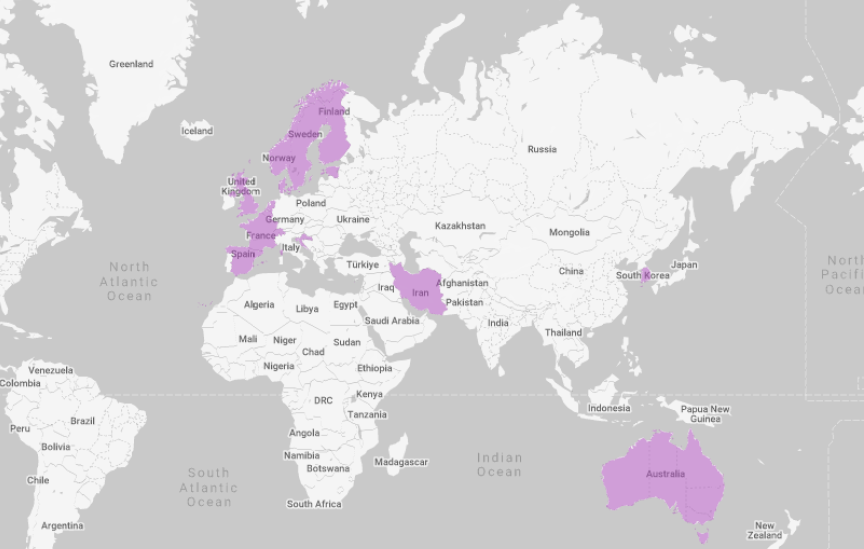
Figure 1: Countries in pink correspond to the Contracting Parties that have ratified the 2009 amendment to the London Protocol as of December 2025.
During the meeting of the Contracting Parties, Germany announced that it was preparing national proceedings to incorporate the amendment into its High Seas Dumping Act. In March 2026 the German Federal Parliament adopted both the 2009 amendment Resolution as well as the 2019 Resolution. This will likely be notified to the IMO during the next meeting in 2026.
While this progress is encouraging, the number of ratifications remains far below the threshold needed for the amendment to enter into force.
The 2019 Resolution: breaking the deadlock
To avoid stalling CCS deployment, Norway, supported by the Netherlands and the United Kingdom, submitted a proposal that was adopted by the Contracting Parties to the London Protocol in a 2019 Resolution, enabling Parties to apply the amendment on a provisional basis.
The Resolution removes the legal barrier that previously prevented the cross-border export of CO₂ for the purpose of geological storage.
Under this pathway, countries must:
- Deposit a declaration with the IMO Secretariat stating that they will apply the 2009 amendment provisionally;
- Conclude a bilateral or multilateral agreement or arrangement with the receiving State;
- Notify the IMO Secretariat of these agreements or arrangements.
Such an agreement must allocate permitting and enforcement responsibilities and ensure full compliance with the London Protocol and international law. Interestingly, a Contracting Party does not have to accept the 2009 amendment to provisionally apply it. However, Contracting Parties relying on the 2019 Resolution generally also proceed with ratification of the 2009 amendment.
Who is already using the 2019 Resolution?
Of the 15 ratifying countries, 12 have also deposited a declaration of provisional application. Only Iran, Estonia and Croatia have yet to do so.
So far, 11 bilateral arrangements have been notified to the IMO:
- Belgium and Denmark (September 2022)
- Denmark and Netherlands (August 2022)
- Belgium and Netherlands (June 2023)
- Denmark and Sweden (April 2024)
- Norway and Belgium (April 2024)
- Norway and Denmark (April 2024)
- Norway and Netherlands (April 2024)
- Norway and Sweden (April 2024)
- Norway and Switzerland (June 2025)
- Norway and Finland (June 2025)
- Norway and France (June 2025)
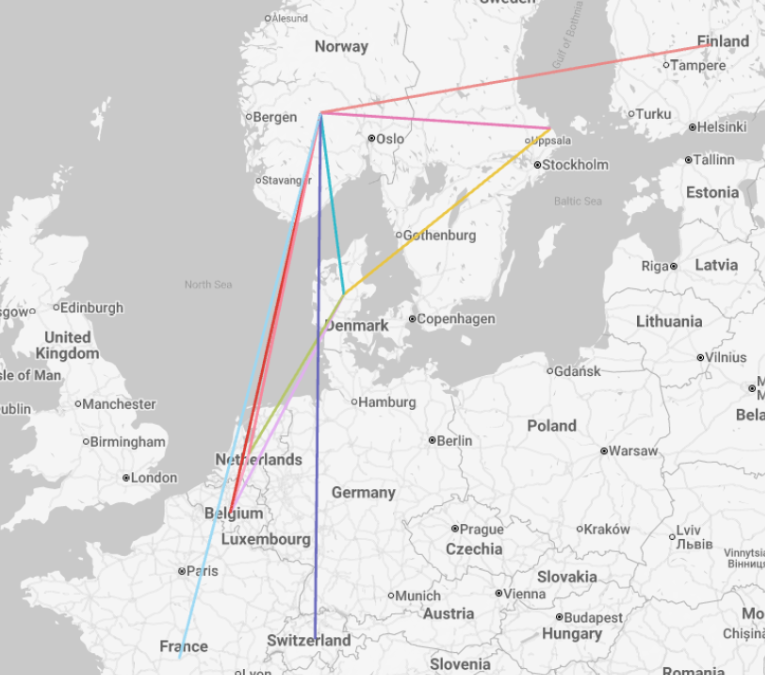
Figure 2: The coloured lines correspond to the 11 notified bilateral agreements between Contracting Parties, which allow for cross-border transport of CO2 for geological storage purposes between those territories. While there might be more bilateral agreements, this figure only covers the ones that have been notified to the IMO Secretariat as of October 2025.
During the meeting, Finland announced that a Memorandum of Understanding with Denmark is also underway and expected to be notified during the 2026 meeting.
What this means for industrial carbon management
The 11 bilateral arrangements demonstrate the catalyst role of the 2019 Resolution, which led to a rapid expansion of cross-border cooperation for industrial carbon management.
They also reveal a clear pattern: the most active States in drawing these agreements, namely Norway, the Netherlands and Denmark, are those with decades of experience in the sector and major flagship CCS projects:
- Norway is positioning itself as Europe’s primary offshore storage provider with its operational storage sites (Sleipner, Snøhvit, and Aurora – Northern Lights)
- The Netherlands is advancing large-scale transport and storage capacity with Porthos (to be operational in 2027) and Aramis (to be operational 2029/2030).
- Denmark, through Project Greensand , expected to be operational in the next few years, is emerging as another North Sea storage hub.
Global momentum for CCS
The last IMO meeting also showed that CCS momentum extends well beyond Europe:
- Australia is consulting on a new offshore CCS framework;
- Japan is implementing its 2024 CCS Business Act;
- The UK continues to advance East Coast Cluster (FID in 2024) and HyNet Northwest (FID 2025).
Together, these developments show that CCS is increasingly becoming part of national industrial and climate strategies worldwide.
The upcoming EU CO₂ market and transport infrastructure framework
The European Commission will soon propose a regulatory framework to create an internal market for CO2 and enable the fast rollout of CO2 transport and storage infrastructure. As part of its public consultation, the European Commission was consulting on how could this initiative address barriers to cross-border transport of CO2 stemming from international and regional treaties.
However, it is important to highlight that the upcoming EU framework cannot directly affect international treaties such as the London Protocol. Therefore, the European Commission can only encourage EU Member States that are Parties to the Protocol to ratify the 2009 amendment and to apply it provisionally through bilateral agreements.
Tackling the fragmentation issue
Currently, participation to the “London regime” remains fragmented.
Most EU and EEA countries are Parties to the London regime. However, some coastal States, potentially interested in offshore storage activities, are not.
- Greece, Malta, Poland and Portugal remain Parties to the London Convention only.
- Latvia, Lithuania, Romania are not party to either instrument.
Where CO₂ is exported to a non-Contracting Party, the Contracting Party must still put in place an agreement or arrangement that complies with the rules of the London Protocol and notify the Secretariat accordingly.
Increasing the number of ratifications of the 2009 amendment, along with expanding the network of bilateral arrangements or agreements, will be key to building a well-functioning European internal market for CO₂ transport and storage.
What lessons does the London Protocol offer to other frameworks?
As CCS projects move from planning to deployment, an enabling international legal framework governing cross-border CO₂ transport and offshore storage will become increasingly important.
The evolution of the London Protocol offers an important lesson in this regard. Over time, it has shifted from a restricted framework to an enabler of international CCS cooperation. This was driven by growing political momentum and by proactive Contracting Parties willing to pursue pragmatic solutions when formal treaty processes stalled.
This shows that, while the European Commission can encourage Member States to tackle existing legal barriers under different international and regional conventions, the decisive factor will be the extent to which Contracting Parties engage proactively within the relevant international forum.
Looking ahead
The 48th Consultative Meeting of Contracting Parties to the London Convention and London Protocol will take place in October 2026. It will provide an opportunity for States to report on progress regarding the acceptance of the 2009 amendment, the declaration of its provisional application under the 2019 Resolution, and the development of bilateral or multilateral agreements. ZEP will continue to engage in these discussions and monitor developments closely as part of its role in advising the EU on industrial carbon management.
Authors

Cristiana Foglia is a Policy Officer at ZEP, where she supports the organisation’s work on advancing evidence-based policy advice to the EU on industrial carbon management. She contributes to ZEP’s policy work, helping shape positions and recommendations on key EU files, including the CO₂ market and transportation infrastructure legislative initiative, lead markets (including the Industrial Accelerator Act), the Net-Zero Industry Act, the EU Climate Law, as well as International Environmental Treaties and Protocols (e.g. London Protocol)
A key part of her role is coordinating and consolidating input from ZEP members, translating diverse and technical feedback into aligned messages. She ensures ZEP’s policy outputs are technically robust, data-driven and clearly framed for engagement with EU institutions and other stakeholders.
Cristiana has a background in European and international law, holding a master’s degree in EU environmental law. Before joining ZEP, she worked in an environmental law firm in Italy, where she gained experience in EU and national environmental and climate legislation. Cristiana is an Italian native speaker; she speaks four languages and is passionate about EU affairs and climate action.