
20 years of ZEP: past milestones and the road ahead
Zero Emissions Platform (ZEP) will celebrate its 20th anniversary in 2026. Since its launch by the European Commission, ZEP has grown from a pioneering initiative into Europe’s advisor on industrial carbon management. Today, it brings together stakeholders from across the value chain to support the development of industrial carbon management solutions required to meet Europe’s climate goals. This article outlines ZEP’s key milestones and the initiatives planned for its anniversary year, including the introduction of ZEP’s new name.
How ZEP began
Twenty years ago, the European Commission created a set of European Technology and Innovation Platforms (ETIPs) to accelerate low-carbon technologies under the Strategic Energy Technology Plan. ZEP was founded in December 2005 as the ETIP for Zero Emission Fossil Fuel Power Plants, with an initial focus on reducing emissions in the power sector.
From the start, ZEP united researchers, industry, and environmental organisations committed to carbon capture and storage (CCS) as a central solution to combat climate change. While ZEP’s focus has broadened beyond the power sector, its mission to contribute to Europe’s climate neutrality target remains unchanged.
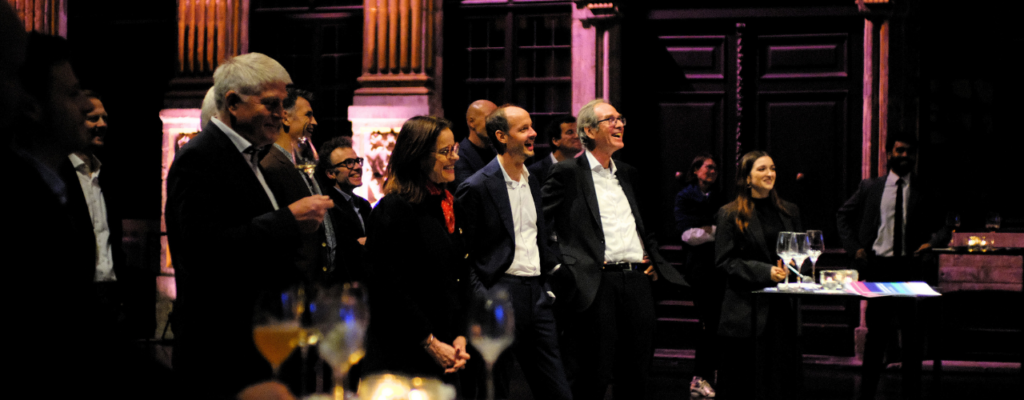
During ZEP’s 20th anniversary reception on 2 December 2025, Charles Soothill, Vice-Chair of ZEP’s Technology and Infrastructure constituency, reflected:
It has been wonderful for me to have worked, for 20 years, with so many committed and diverse Europeans engaged in energy and climate. Meeting our climate targets demands that we do everything we can. Carbon capture and storage (CCS) is essential in this mix.
Two decades of policy advice, technical work, and progress
For two decades, ZEP’s policy analysis and technical advice have informed the EU climate and energy policy. Some of these contributions stand out as milestones in the evolution of industrial carbon management. Let’s explore them.
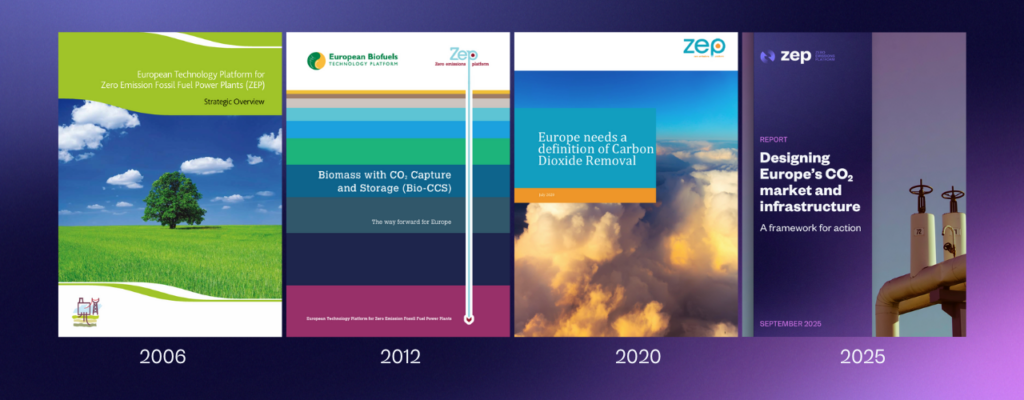
2006: The Strategic Overview
In 2006, ZEP published the Strategic Overview, setting two key pillars:
- Strategic Deployment Document (SDD): guidance on accelerating market deployment.
- Strategic Research Agenda (SRA): described a collaborative programme for technology development to reduce costs and risks.
2008: Shaping the NER300
ZEP played a central role in shaping the New Entrants Reserve (NER) 300 Programme, which became the key funding mechanism for first-of-a-kind CCS projects in Europe. ZEP’s role in this process extended beyond policy design: in 2009, it developed a comprehensive framework to enable knowledge sharing across projects.
2009-2011: Work on the CO2 Storage Directive
Following the adoption of the CO₂ Storage Directive in 2009, ZEP monitored progress on its implementation in 2010 and advised the Commission on research and development funding priorities.
In 2011, ZEP continued to play an instrumental role in improving market transparency and enabling information sharing, publishing landmark reports investigating the costs of CO₂ capture, transport, and storage.
2012: Pioneering carbon dioxide removals through CCS
Together with the European Biofuels Technology Platform, ZEP published Bio-CCS: The way forward for Europe, one of the first efforts in Europe to establish large-scale carbon dioxide removals through CCS.
Jonas Helseth, Vice-Chair of ZEP’s civil society organisations constituency, noted:
This landmark report laid the foundations not only for CDR efforts in Europe and for the IEA, but also in the US.
2013: Refocusing on energy-intensive industry
With several NER300 projects not reaching operation, ZEP shifted towards Europe’s energy-intensive industries. The report CCS in energy-intensive industries: an indispensable route to an EU low-carbon economy identified sectors such as cement, chemicals, and steel, where little or no alternatives to CCS existed.
Jonas Helseth commented:
This report was instrumental in changing the perception of CCS, moving the technology out of the EU’s misguided, singular focus on the power sector, toward key welfare-carrying sectors that underpin the green shift and depend on CO2 infrastructure for net zero compliance.
2014-2020: Laying the groundwork for today’s policies
As NER300 projects were abandoned and the funds went unspent, ZEP published a series of reports that ultimately led to the pathway taken at the EU level nearly a decade later.
Key works included:
- 2014: ZEP outlined how business models for CCS could be developed. This was followed by key recommendations to reform the Emissions Trading System and establish what would become the Innovation Fund.
- 2015: The Executable Plan for Enabling CCS in Europe highlighted the need to shift focus from point-to-point CCS projects to building hubs and clusters. This report became the benchmark of today’s EU carbon management policy framework.
- 2020: Europe needs a definition for carbon dioxide removal (CDR) was the first-of-a-kind effort to develop CDR in Europe, and would become the basis for the EU Carbon Removal and Carbon Farming Regulation.
2020-2025: evolving to keep advancing industrial carbon management
ZEP expertise now spans the full industrial carbon management value chain – covering CCS, CCU, and CDR. More than 36 diverse members collaborate to address technical challenges and inform the policy frameworks required for deployment.
Recent developments reflect this growth, including:
- ICM Summit (since 2023): an annual Brussels gathering bringing the carbon management community together to advance Europe’s policy agenda.
- Projects Network (launched 2024): a platform for project developers to share knowledge and learn from real-world projects.
- Modernised identity and website (2025): a refreshed visual identity and website, including a new logo symbolising ZEP’s mission to close the carbon cycle.
During his speech at the 20th anniversary reception, Charles Soothill reflected on ZEP’s evolution and said:
This reminds me of critical meetings with Pedro Sampaio Nunes (Head of Energy) in 2003/04, when he told Nick Otter not to stop what he was doing to bring the energy constituencies together. He said, “Keep going, Nick”. Well, we have! My congratulations to the whole community. There is still far to go, but we can be happy today with ZEP’s contribution and can look forward with confidence.
2026: fresh initiatives, improved structure, new name, same mission
The 20th anniversary marks both a celebration and a strategic opportunity to prepare for ZEP’s next chapter. In 2026, major initiatives will strengthen engagement and further advance its mission.
Communications and engagement
- A redesigned newsletter: providing clearer updates on ZEP’s policy advice, technical work, and events. Subscribe here.
- Quarterly drinks: informal gatherings for members and partners to exchange ideas.
- An improved website with enhanced navigation and expanded features.
- A ZEP Archives series: monthly LinkedIn carousels revisiting ZEP’s milestones reports.
Strategic developments
- A new name: in 2026, ZEP will become Carbon Management Europe (CME), aligning with EU terminology and better reflecting its mission.
- A new structure: designed to support a growing membership.
As industrial carbon management in Europe moves from isolated projects to large-scale deployment, ZEP – soon to become Carbon Management Europe (CME) – will continue to serve as Europe’s advisor on the carbon management solutions and policy frameworks required for climate neutrality.
As rightly summarised by ZEP/CME Chair, Eve Tamme:
For twenty years, ZEP has united industry, researchers, and civil society around a shared vision for Europe’s path to climate neutrality. Together, we have built the foundation for industrial carbon management as a core pillar of that journey. As deployment scales up and policy ambition grows, ZEP/CME remains committed to providing policymakers and project developers with rigorous, evidence-based advice to turn vision into lasting impact.
Authors

Amélie Trémolières is the Communications Manager at ZEP, where she leads the organisation’s communications strategy across institutional communications, policy communications, events, and media relations. She ensures ZEP’s work on climate policy and carbon management technologies is clearly framed, visible, and reaches the right audiences to support ZEP’s objectives.
Before joining ZEP, she worked in several European policy environments, including think tanks such as the Centre for European Policy Studies, government institutions including the French Consulate, and the General Secretariat of the Council of the EU as a digital communications trainee. She also spent two years as Communications and Events Operations Lead at a Brussels-based European association.
She has expertise in media relations, social media strategy, website management, and branding. Amélie holds an academic background in EU studies and political and public communication, is a native French speaker, and has a strong interest in climate and EU policy.

Eadbhard is the Secretary General of the Zero Emissions Platform. In this role, he oversees the management of the secretariat team and the health of the organisation. Eadbhard has a background in energy and climate law and has worked to advance carbon management as a climate mitigation tool in Europe for several years, previously leading the European policy work at the climate NGO, Clean Air Task Force. Originally from Ireland, Eadbhard is half-Dutch and can be contacted in English, German, possibly Dutch and maybe even French if he ever bothers to learn it.